
From side project to full time; 12 months of open source
Some lessons learnt turning my open source side project into a full time job.

Yesterday it was a year since I left AWS to go full time in open source. Time has flown. There has been lots of lessons and insights.
In the nature of public/sharing in public here are some thoughts. This is a mix of open source thoughts, and also product learnings.
At the end of the blog there are a list of podcasts and videos I recommend subscribing too.
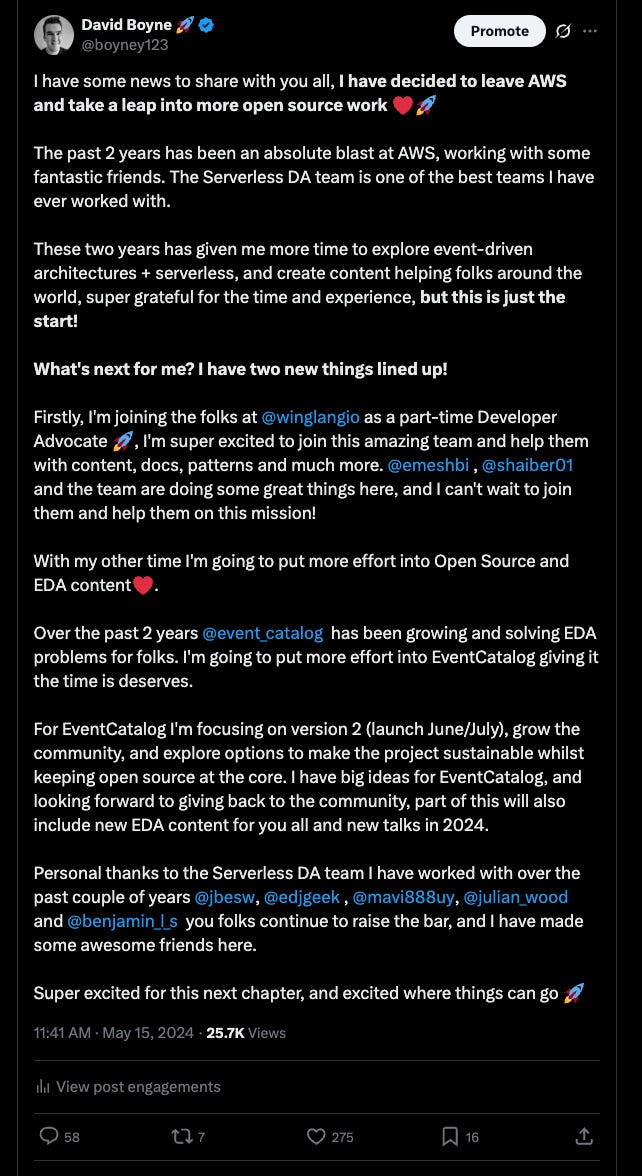
Taking the leap from side project to full time
The first step is the hardest. Taking the leap.
This was the scariest decision throughout the year. Leaving a great job (and salary!) to try and turn my side project (https://www.eventcatalog.dev/) into a sustainable model.
My goal; Can I turn my open source project into a sustainable model?
I decided to work part time with Wing and initially do 2 days a week with EventCatalog. This helped me pay my mortgage and put food on the table for my kids (I think that’s important? Right!? 😝)
This can be a great path to your sustainable open source project. Start part time, work out a business model and the go full time…. (clear now I look back… not exactly what I did though).
After 5 months, I decided to go full time on EventCatalog. The project required it, the pull requests and issues were growing and the project demanding more time. So I left Wing and went full time (without a business model…. mistake).
Turns out having a open source business model, is kinda hard. Actually making money from open source is hard….but not impossible (more on this later).
Before you jump ship, think about your business model if this is something you want to take into consideration. Who are your users? Who are your customers? What problems do they need solving? What will they pay for?
Also realise that because your project is open source it does not mean your time is free. It’s easy to fall into this trap. I know it’s all about community (it is for me anyway), but you have to frugal with time… and value it.
Value your time, and project. Just because it’s open source does not mean you have an obligation to make it free for everyone, every feature and unlimited support.
⭐️ Lesson learnt; If you take the leap, it’s a wild ride! One way to learn? Throw yourself in the deep end, get comfortable being uncomfortable, step outside your comfort zone. Others have done this, turned side projects into sustainability, why can’t you? (so I keep telling myself… daily!)…
Open source creates your champions
Open source projects are great for community, and attracting people to your problem space. EventCatalog is all inbound at the moment, but the project continues to grow 10% every month and has for the year.
I believe that open source products create trust and hardness community. This is a huge part of my personal values, working with others and helping people. Open source gives EventCatalog a platform to grow on.
For the past 12 months most of EventCatalog traffic is word of mouth and discovery from folks. I think open source products help with that.
Your champions start to create pull requests, to help embed your product into their organizations. This is a great feeling.
⭐️ Lesson learnt; To scale your project (as a solo founder) create advocates out there, your champions. Work with them. Let them sell your product to their organisations. Help them do this.
It’s hard to sell open source software (but not impossible).
It’s actually quite hard to sell open source software, especially in the developers tools space. Most developers hate sales people, and paying for tools (I’m one of them).
I learnt that most my customers are Architects and C Level folks. They understand the value EventCatalog can bring and the problem space I’m trying to address.
If I was selling to developers…. I will probably be a different story….
So, how does EventCatalog make any money?
I decided to turn EventCatalog into an open core model. This means certain features of EventCatalog are paid for only (e.g integrations). This helps the project sustain and allows me to work on this full time.
Although open core is working, it’s still a very conflicting. Part of me wants to unlock all the features for everyone without the need to purchase licenses….. but it’s not sustainable. The other solution is for a BSL license, or get folks over X revenue to pay for EventCatalog…. but that brings its own problems… so, for now this works fine.
⭐️ Lesson learnt; You need to understand your users and your customers (both have different needs). Your customers are those willing to pay for your work. Understand the customer segments, and above all things, go speak to them, learn about their problems.
You will feel bad for not moving fast enough
As the project gets more traction it’s hard to keep on top of issues and pull requests.
This can make you feel like shit (it does for me).
But you have to come to terms with it and figure out ways to scale.
Something I want to do this year is start to find maintainers or a core team that will help, but I want to pay for their time…. so once the project hits more sustainability this will help.
In the meantime, something that helps me is upvotes on my GitHub issue templates.
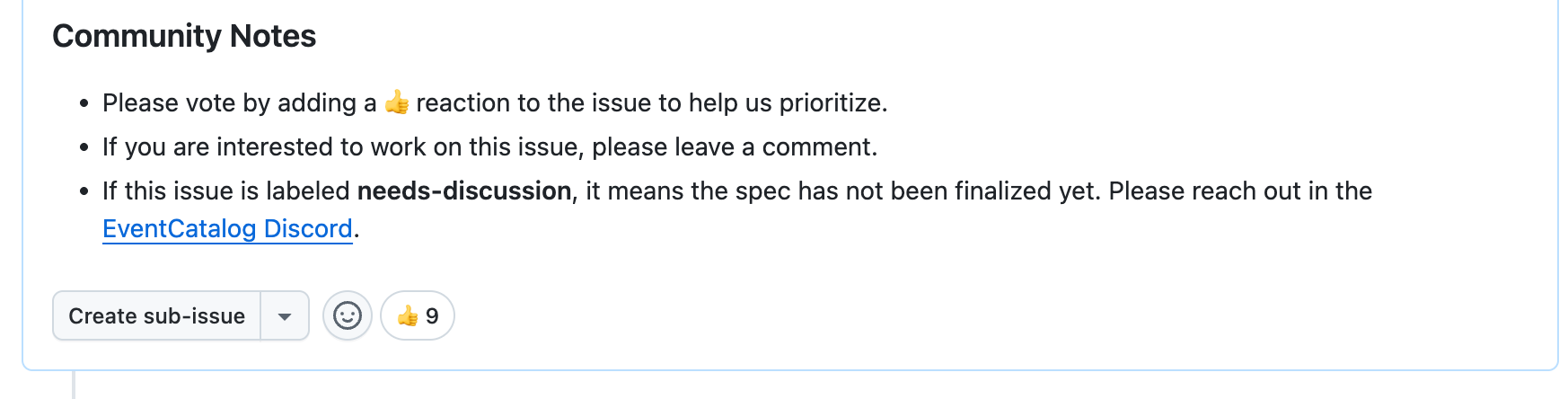
Although not perfect, this helps me find issues that are a problem for a group of users, and helps me focus on them. (if they are easy small wins, then I just fix them).
⭐️ Lesson learnt; Figure out a way of working, and be transparent about it. It won’t be perfect, but nothing is. Learn and move.
The trap of feature development
More of a technical founder thing, but it’s easy to just add features, I’m very aware of this, and still fall into this trap all the time!
You naturally want to focus on code and features and keep releasing things (it’s the sexy thing to do)…. but if you are turning your project into a product, you need to have a product mindset.
This means focus on material, marketing, documentation, and features.
⭐️ Lesson learnt; Find problems from your users, then fix them. This is your backlog.
Mindset change from open source project to product
As I mentioned above, your open source project might of started as a side hobby, thought, or idea.
If you want to turn it into a product for people, and something people will pay for (sustainable open source), you need to think about product thinking.
Work out who are your customers, and who are your users.
⭐️ Lesson learnt; TALK TO PEOPLE. Stop coding, and work on problems.
Talking to people
I know it’s hard right? But you have to. Get into their problems, empathise with them, don’t talk about solutions. Dive deeper with them. Write notes.
Next cross reference your notes with other users.
These are your problems and roadmap.
⭐️ Lesson learnt; Don’t lead with solutions, dive deeper into problems.
Docs and your landing page are important
Your docs and landing pages are important.
My experience, if you want an open source project with users, you have to have clear documentation, and bonus points for a landing page.
I use https://docusaurus.io/ and have been for 10+ years now (I think), and it’s great.
My workflow is:
Fix bug / feature
Write the docs (with an AddedIn note, which version)
Add images in docs
Update any landing pages if you have too
Let people know on socials and discord
Repeat
Figure out your workflow. But wrap up your features and fixes. Share them with the world. More people are interested than you think.
⭐️ Lesson learnt; Wrap up changes into code, docs, videos, social media and more… its not just code.
Summary
I’m sure there is more lessons learnt, but these are on the top of my head.
If you found anything interesting or have questions feel free to reach out. Happy to help!
Here are a list of resources that have helped me:
This is a great podcast. Really like the tone and discussions. If you are open source and bootstrapping there a few episodes here that can help!
Another great podcast to checkout. Some great interviews here.
Podcast for Bootstrapped SaaS folks. Lot’s of interesting talks here.
Designing the Ideal Bootstrapped Business with Jason Cohen
Old(ish) one but still good. I like Jasons thoughts on all this and some great insights here.
Not sure if I should mention this one or not, lots of tech bros vibes here, but good insights in some videos so worth diving into it.
If you would like to continue to follow my journey feel free to subscribe, and I will post future ramblings about all this stuff!